
-
April 22, 2026
Off-Site Records Storage vs. In-House Storage: A Cost and Risk Comparison
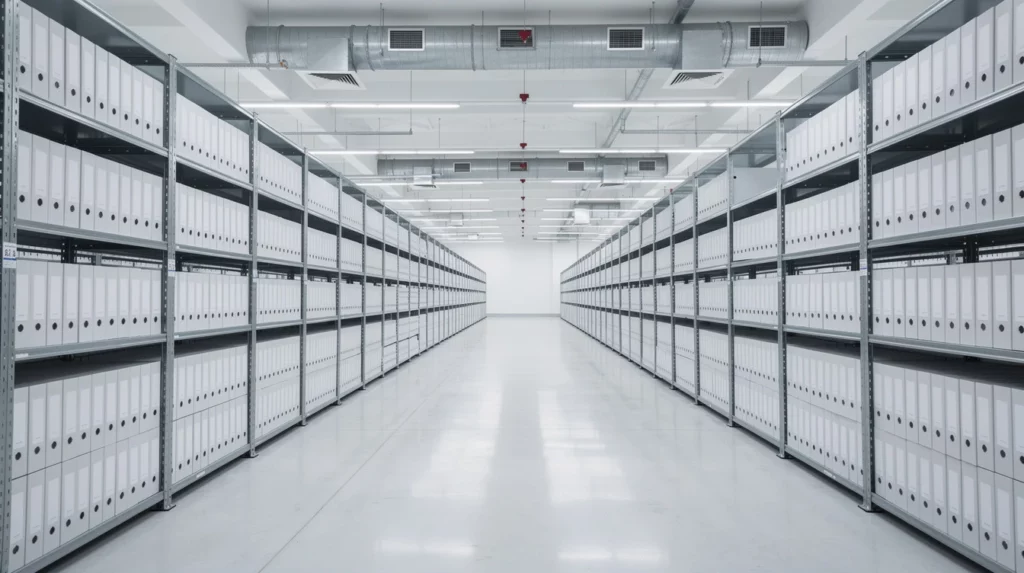
When organizations evaluate their document management strategy, the decision between off-site records storage and maintaining in-house filing systems represents a significant operational choice. We have observed that businesses across Connecticut, Massachusetts, Rhode Island, and New York often underestimate the true cost of keeping records on-site while overestimating the complexity of transitioning to professional storage solutions.
The Hidden Costs of In-House Storage
Many organizations calculate storage costs by simply tallying the price of filing cabinets and boxes. This approach overlooks substantial expenses that accumulate over time.
Commercial real estate in our service area ranges from fifteen to forty dollars per square foot annually. When a conference room becomes a document repository or valuable office space houses banker boxes, those square feet represent direct costs. A modest 200-square-foot storage area can cost between three thousand and eight thousand dollars yearly in rent alone.
Beyond real estate, in-house storage demands climate control, security systems, fire suppression equipment, and insurance coverage. Staff time spent retrieving documents, managing filing systems, and conducting periodic purges represents another significant expense rarely captured in budget discussions.
Risk Factors Most Organizations Miss
We encounter businesses every week that maintain critical records in basement storage rooms, converted closets, or warehouse corners. These arrangements expose organizations to multiple risk categories.
Fire and water damage top the list of physical threats. Standard office sprinkler systems and firefighting efforts can destroy paper records as effectively as flames. Flooding from weather events, plumbing failures, or roof leaks creates similar catastrophic loss scenarios.
Security vulnerabilities multiply when records sit in general office areas. Employee access controls become difficult to enforce. Visitors, maintenance contractors, and cleaning crews may inadvertently access sensitive documents. Preventing unauthorized access requires constant vigilance and often fails during after-hours periods.
Compliance failures represent perhaps the most serious risk. Retention schedules become nearly impossible to enforce when documents scatter across multiple on-site locations. The inability to produce specific records during audits or legal proceedings creates liability exposure far exceeding any storage cost savings.
Professional Off-Site Storage Advantages
Our climate-controlled storage facility addresses each risk factor systematically. Purpose-built warehouses maintain consistent temperature and humidity levels that preserve document integrity for decades. Advanced fire suppression systems protect records without water damage risks.
Security measures at professional facilities exceed what most organizations can implement internally. We maintain twenty-four-hour surveillance, restricted access protocols, and detailed chain-of-custody documentation. Every box retrieval and return generates an audit trail.
Cost structures become predictable and scalable. Organizations pay only for space actually used, eliminating the waste inherent in maintaining excess capacity for peak storage needs. As document volumes fluctuate, costs adjust accordingly without requiring new real estate decisions.
Operational Efficiency Gains
The transition to off-site storage typically liberates between one hundred and five hundred square feet of office space. Organizations can redeploy this area for revenue-generating activities rather than passive document housing.
Staff productivity improves when employees stop functioning as informal records managers. Professional retrieval systems deliver requested documents faster than most internal filing operations, often within hours of request submission.
Disaster recovery planning becomes significantly simpler. Off-site storage provides automatic geographic separation between primary operations and backup records, a fundamental best practice many organizations struggle to achieve through internal efforts.
Making the Transition
We work with organizations throughout Connecticut, Massachusetts, Rhode Island, and New York to implement storage transitions without operational disruption. The process begins with inventory assessment, continues through secure transport, and concludes with online access systems that provide visibility into stored materials.
Most businesses discover that professional storage costs less than their current approach while delivering superior protection and accessibility. The decision ultimately reflects organizational priorities regarding risk management, compliance, and resource allocation.
Call us at (860) 627-5800 or complete the form on this page today!
Contact Us
Popular Posts
Helpful Resources
Interested in Shred Events?
Come be a part of one of Infoshred’s upcoming Shred Events! We provide a safe, eco-friendly way to dispose of your confidential paper documents. With easy-to-reach locations and convenient dates, we’re here to help you safeguard your information while giving back to local causes.

Our Certifications and Accreditations
Infoshred’s certifications demonstrate our unwavering commitment to security, compliance, and environmental responsibility in all aspects of document and data destruction.